Catalyst supports are indispensable for efficient water dissociation since they play key roles in either indirectly enhancing catalysis activity by modifying electronic structures of catalysts or directly participating in catalytic reaction. MXene has recently emerged as a promising catalyst support for water dissociation by virtue of its rich surface electronic states that enable various electronic modifications of catalysts, but its potential of directly interacting with reactants or products to accelerate catalytic dynamics in water dissociation remains unexplored. Here we report our finding that phosphate anion-engineered MXene is capable of significantly accelerating water dissociation on single-atom ruthenium-copper (Ru–Cu) alloy, achieving a record-high mass-specific activity of 746 L gRu−1 min−1 under light conditions at room temperature. This is mainly enabled by the accelerated hydrogen spillover effect, which results from the phosphate anion-induced electronic modification of titanium sites on MXene following the light-enhanced activation of ammonia borane and water molecules on Ru–Cu active sites. This underlying mechanism is elucidated by a combination of in situ spectroscopic characterizations and density function theory calculations. This work unveils a previously unrecognized catalytic role of MXene-based supports and offers a new design strategy for enhancing water dissociation through tailored support-catalyst-reactant interactions.
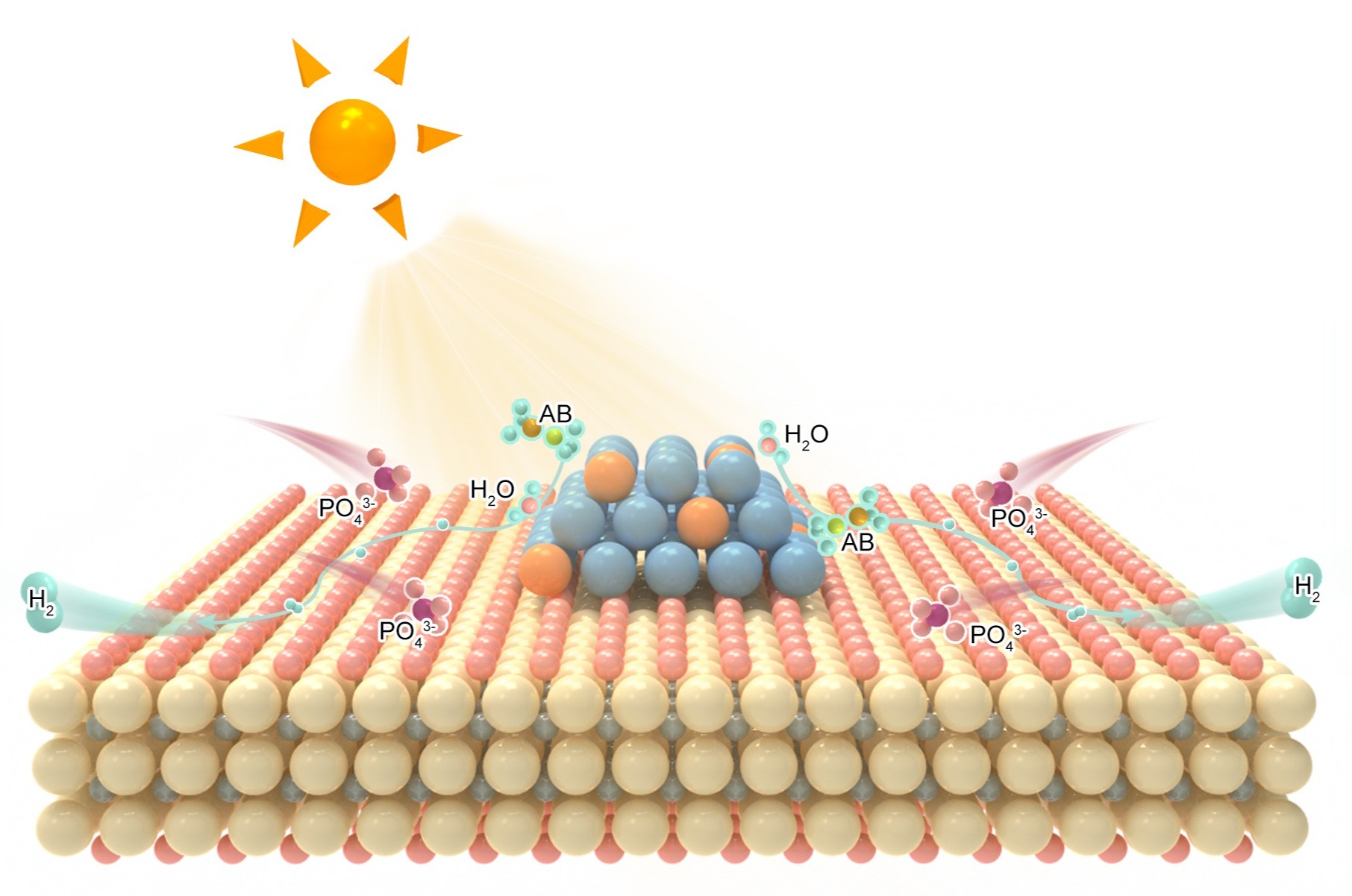
Figure :Hydrolysis Mechanism Diagram
Article link: https://onlinelibrary.wiley.com/doi/abs/10.1002/anie.202524246

