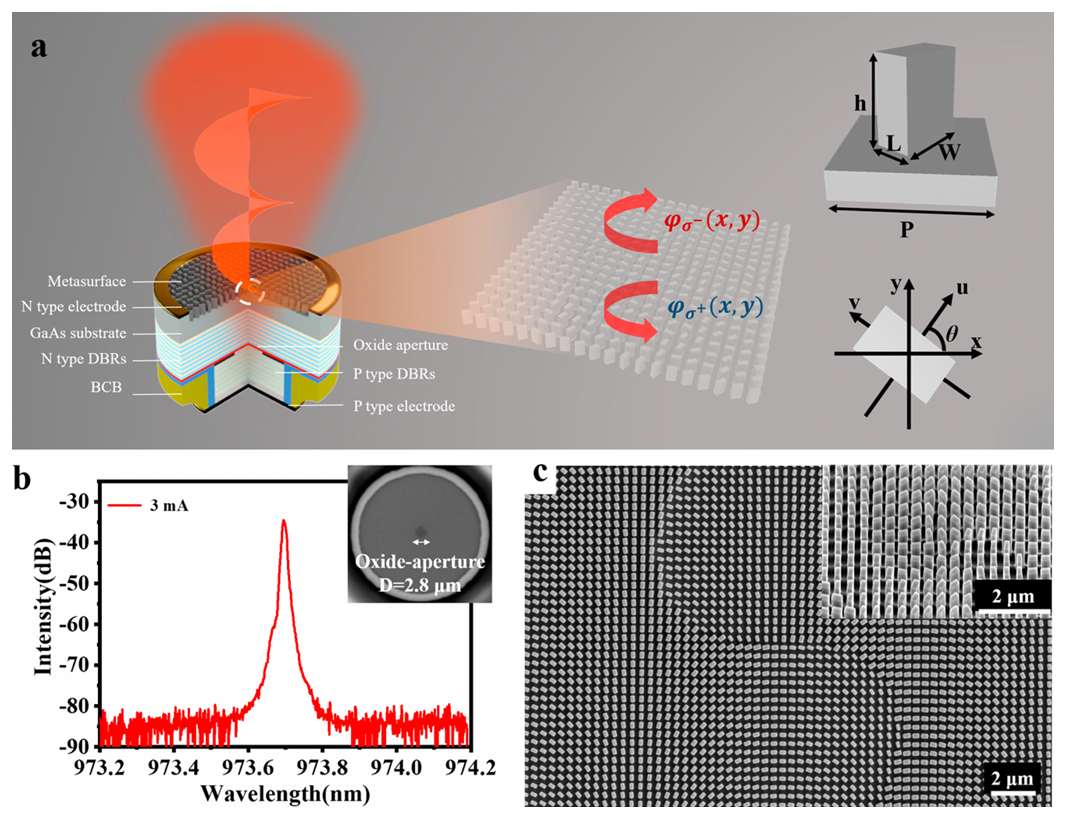
The teams led by Prof. Yi-Yang Xie at Beijing University of Technology and Prof. Qiang Kan at the Institute of Semiconductors, Chinese Academy of Sciences, in collaboration with the team led by Prof. Pei-Nan Ni at Zhengzhou University, proposed an on-chip strategy for generating perfect Poincaré beams. This work aims to overcome the efficiency and scalability bottlenecks of conventional approaches, which typically rely on bulky external optical systems.
The researchers designed an innovative chip-scale light source based on a monolithically integrated metasurface and a vertical-cavity surface-emitting laser (VCSEL). By using spin-decoupling as the core physical mechanism, the device enables precise control of the emitted laser field. Through direct integration of a carefully designed metasurface onto the VCSEL chip surface, the system can efficiently generate perfect Poincaré beams on chip without any external optical components or complex alignment procedures.
The generated beams feature high directionality and on-demand control of orbital angular momentum, polarization order, and output angle. This work provides a compact, stable, and scalable light-source platform for frontier applications such as quantum information processing, super-resolution imaging, and high-dimensional optical communications.
This work, entitled “Directional Perfect Poincaré Beams Generated by Spin-Decoupling of VCSELs Using Integrated Metasurfaces,” was published in Nano Letters on September 16, 2025.